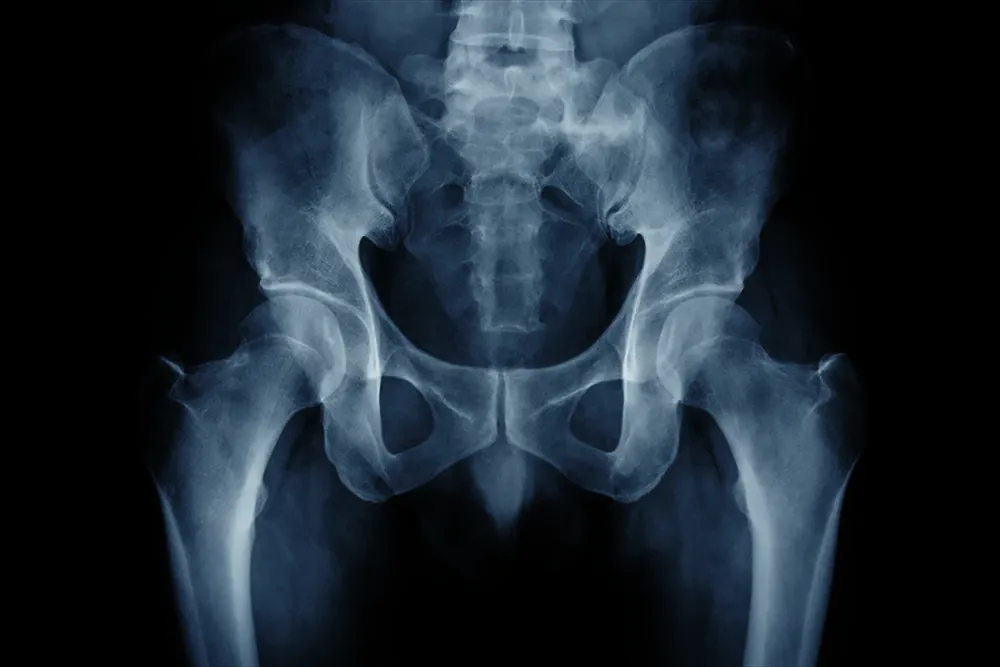
DEXA Osteoporosis Screening
Understand Your Bone Health
What an Osteoporosis Screening Scan Measures
The scan focuses on your hips and spine — the areas most vulnerable to fracture and the standard sites for diagnosing osteoporosis. Available at all of our Rancho Mirage, San Dimas, and Temecula locations. Learn how DEXA scanning works.
Dual Femur (Hip) Scanning
Both left and right femoral necks are scanned individually. The hip is one of the most important areas to measure for bone health. Knowing your numbers here helps guide treatment decisions.
Lumbar Spine (L1–L4)
Your lower spine is one of the first areas to show bone loss. We measure bone mineral density across four vertebrae for a comprehensive picture.
T-Score and Z-Score
Your T-score compares your bone density to a healthy 30-year-old — the standard for diagnosing osteoporosis and osteopenia. Your Z-score compares you to others your age.
Independent Radiologist Interpretation
Every osteoporosis screening includes a final interpretation by an independent board-certified radiologist, including osteoporosis and osteopenia indications if relevant.
Your bone density at 55 is not what it was at 35. A baseline scan tells you exactly where you are — and gives you and your doctor something concrete to act on.
Book Your Osteoporosis ScreeningIt cannot be emphasized enough that broken bones due to osteoporosis are not just painful, they are all too often a cause of life-changing disability and loss of independence.
The gold standard for assessing bone health is DEXA. This important test can warn you before you break a bone.

This important test can warn you before you break a bone. The time to think about your bone health is long before you're laid up with a fracture.

Should You Get a Bone Density Scan?
You don't need to wait for a doctor to tell you. If any of these apply, Desert Dexa can give you answers.
Women approaching or in menopause
Bone density can change significantly during and after menopause. Screening gives you a clear picture so you can take proactive steps with your doctor.
Men over 50
Osteoporosis affects men too, and it's significantly under-screened. Knowing your bone density gives you a head start on maintaining bone health.
Family history of fractures
If a parent or sibling has broken a hip or been diagnosed with osteoporosis, your risk is higher. A scan tells you where you actually stand.
Long-term medication use
Corticosteroids, thyroid medications, and some antacids can weaken bones over time. If you've been on them for months, screening is smart.
Low body weight or small frame
Less body mass means less bone density to begin with. If you've always been thin, it's worth knowing your baseline.
Anyone who wants a baseline
You can't track bone health if you never measure it. A baseline scan now makes future scans far more useful.
Bone health responds well to early intervention. A scan now gives you the lead time to actually do something about it.
Schedule Your Osteoporosis Screening ScanFrequently Asked Questions
Do I need to prepare before my DEXA scan?
No preparation is needed for a scan at Desert Dexa. Eat, drink and take your medications normally — DEXA is not affected by a recent meal or your hydration the way bioimpedance devices are. The one thing that matters is clothing without metal: zippers, underwire and belt buckles sit in the scan field.
What is a DEXA scan?
A DEXA (or DXA) scan uses two low-dose x-ray energies to separate your body into fat, lean tissue and bone. That separation is why it can report each arm and each leg individually rather than one whole-body figure. Desert Dexa runs clinical-grade DEXA scanners at our Rancho Mirage, San Dimas, and Temecula locations in Southern California, for body composition and for bone density.
How long does the DEXA scan take?
About 15 minutes on the table at any Desert Dexa location, or roughly 20 for the Combo. You lie still, fully clothed, while the scanner arm passes over you — nothing touches you and nothing is injected. Your Total Body report is emailed afterwards, with a link to book a complimentary phone or video review with a trained body composition analyst; the Osteoporosis Screening report is written by a radiologist and follows within about 3 days.
How much does a DEXA scan cost?
At Desert Dexa, the Total Body (body composition) scan starts at $50, the Osteoporosis Screening scan starts at $80, and the Combo, which includes both, starts at $100. Monthly and quarterly options are available for each. We are cash-pay and accept credit and debit cards, so the price you book at is the price you pay — no facility fee and no separate radiology bill.
Do I need a doctor's referral for a DEXA scan?
No. You book online and come in, including for the osteoporosis screening scan. Most providers make you obtain a physician order first; our own physician orders the scan, so there is nothing for you to chase and no insurance pre-authorization to wait on. The report is written so you can hand it straight to your own physician afterwards.
Is a DEXA scan safe?
Yes. A DEXA scan uses an extremely low dose of x-ray radiation, comparable to what you would receive from eating three bananas, and it is considered very safe for most people. Desert Dexa does not scan anyone who is pregnant or may be pregnant, or who has had a contrast or nuclear medicine study in the past seven days.
What should I wear to my DEXA scan?
Comfortable clothing with no metal on it. Metal — zippers, buttons, underwire — sits in the scan field and can affect accuracy, so activewear such as leggings and a plain T-shirt is ideal, and a sports bra is preferable for women. You stay fully clothed throughout the scan at Desert Dexa.
How often should I get a DEXA scan?
For body composition, many Desert Dexa clients scan every month to see how training and nutrition are moving fat and lean mass, which is why we offer monthly and quarterly options alongside one-time scans. For bone density, follow-up timing is a clinical decision your physician makes from your first T-score and your risk factors.
Do you accept insurance for DEXA scans?
No. Desert Dexa is cash-pay and accepts credit and debit cards only. That is what keeps the price flat and the wait short — there is nothing to authorize and no claim to file. Many clients find it costs less than what a copay or deductible would have taken.
Why choose DEXA over other body composition methods?
Bioimpedance scales and handheld analyzers pass a current through you and infer the rest, which is why the reading moves when you drink water. DEXA images tissue directly. Desert Dexa uses clinical-grade DEXA and reports regional and total body fat, lean mass by limb and bone density from one 15-minute scan — measurements a scale, calipers or a gym analyzer cannot produce.
Do DEXA scans measure visceral fat?
Yes, and every Desert Dexa Total Body scan reports it as its own value rather than an add-on. Visceral fat sits around your organs rather than under your skin, so neither a scale nor a mirror gives any read on it, and it tracks with metabolic risk more closely than total weight does.
Why should I get a bone density scan?
Bone loss is silent — most people have no idea where they stand until a fracture proves it. A Desert Dexa osteoporosis screening scan measures your hips and spine and returns a T-score, a Z-score and BMD for each site, with a radiologist's final interpretation you can take to your doctor.
What happens during a DEXA scan at Desert Dexa?
You stay fully clothed and lie still on a padded table while the scanner arm passes over you. Nothing touches you, nothing is injected, and there is no tunnel or enclosure. It takes about 15 minutes for a single scan and roughly 20 for the Combo. A Desert Dexa technician positions you at the start and reviews your Total Body results with you at the end.
When will I get my DEXA scan results?
Your Total Body (body composition) report is emailed to you after your visit at Desert Dexa. It includes a guide to interpreting your own results and a link to book a complimentary phone or video review with a trained body composition analyst, at a time that suits you. The Osteoporosis Screening report is different: it is written by an independent board-certified radiologist and reaches you within about 3 days.
What is on a Desert Dexa Total Body (body composition) report?
More than 10 pages. Fat and lean mass overall and by region, muscle symmetry comparing your left side against your right, and visceral fat as its own value. Then resting metabolic rate derived from your measured lean mass, and Appendicular Lean Mass Index. It also reports total body bone mineral density with a T-score and Z-score, plus regional readings for arms, ribs, legs, spine, trunk and pelvis. It also includes a guide to interpreting your own results.
Can I share my DEXA results with my doctor?
Yes — both reports are yours to share. The Desert Dexa Osteoporosis Screening report is written by the radiologist and designed to hand off to your physician, with T-score, Z-score and BMD for each femur and the spine, and osteoporosis or osteopenia indications where they apply. The Total Body (body composition) report can be shared the same way.
Does it matter where I get my DEXA scan?
Yes. DEXA accuracy depends on calibration and a stable scanning environment. Desert Dexa's scanners are fixed-site clinical systems in permanent rooms — not mobile units transported in vans and re-levelled in a parking lot — which is what makes your second scan genuinely comparable to your first. We also offer both body composition analysis and clinical osteoporosis screening with independent radiologist interpretation; most providers offer one or the other.
What is a DEXA bone density scan?
At Desert Dexa, it's a 15-minute scan that measures your bone mineral density using low-dose x-ray. You get a T-score and Z-score — the standard metrics doctors use to diagnose osteoporosis and assess fracture risk. Learn more about how DEXA scans work.
What's a T-score?
Your T-score compares your bone density to a healthy 30-year-old. A score above -1 is normal. Between -1 and -2.5 means low bone mass (osteopenia). Below -2.5 means osteoporosis.
Why get screened if I feel fine?
Osteoporosis has no symptoms. You can lose bone for years and never feel a thing. For most people, the first sign is a fracture — and by then, significant bone loss has already happened.
What happens during the scan?
You lie on a padded table fully clothed. A scanner arm passes over your body. It takes about 15 minutes. No injections, no fasting, no prep.
Our Locations
Rancho Mirage
Coachella Valley / Palm Springs
69848 Highway 111 Suite 7
Rancho Mirage, CA 92270
San Dimas
San Gabriel Valley / Inland Empire
237 W Bonita Ave Suite B
San Dimas, CA 91773
Temecula
Temecula Valley / SW Riverside
27349 Jefferson Ave Ste 104
Temecula, CA 92590
DEXA bone density screening available near you: Rancho Mirage, Palm Springs, Palm Desert, Cathedral City, La Quinta, Indian Wells, Indio, Desert Hot Springs, Coachella, Bermuda Dunes, Thousand Palms, Banning, Yucca Valley, San Dimas, Claremont, Upland, Pomona, Glendora, La Verne, West Covina, Covina, Diamond Bar, Rancho Cucamonga, Ontario, Montclair, Azusa, Fontana, Charter Oak, Citrus, Vincent, Walnut, Rowland Heights, Valinda, Baldwin Park, Arcadia, La Puente, El Monte, Monrovia, Hacienda Heights, Chino, Temple City, Chino Hills, Pasadena, Los Angeles, Eastvale, Corona, Jurupa Valley, Bloomington, Rialto, Norco, Colton, San Bernardino, Riverside, Duarte, South El Monte, Rosemead, San Gabriel, Alhambra, Monterey Park, Montebello, East Los Angeles, Whittier, La Habra, Temecula, Murrieta, Menifee, Wildomar, Lake Elsinore, Canyon Lake, Winchester, Hemet, San Jacinto, Perris, Fallbrook, French Valley, Lakeland Village, Good Hope, Temescal Valley, Mead Valley, East Hemet, Escondido, Oceanside, Vista, Moreno Valley, and San Marcos.
Ready to See Your Numbers?
Book a DEXA scan at our Rancho Mirage, San Dimas, or Temecula location. No referral needed.
Want to learn more? Read our articles on body composition and bone health.